Penomo @SuperReturn Berlin - AI in Energy Transition Finance. Read more
3
min
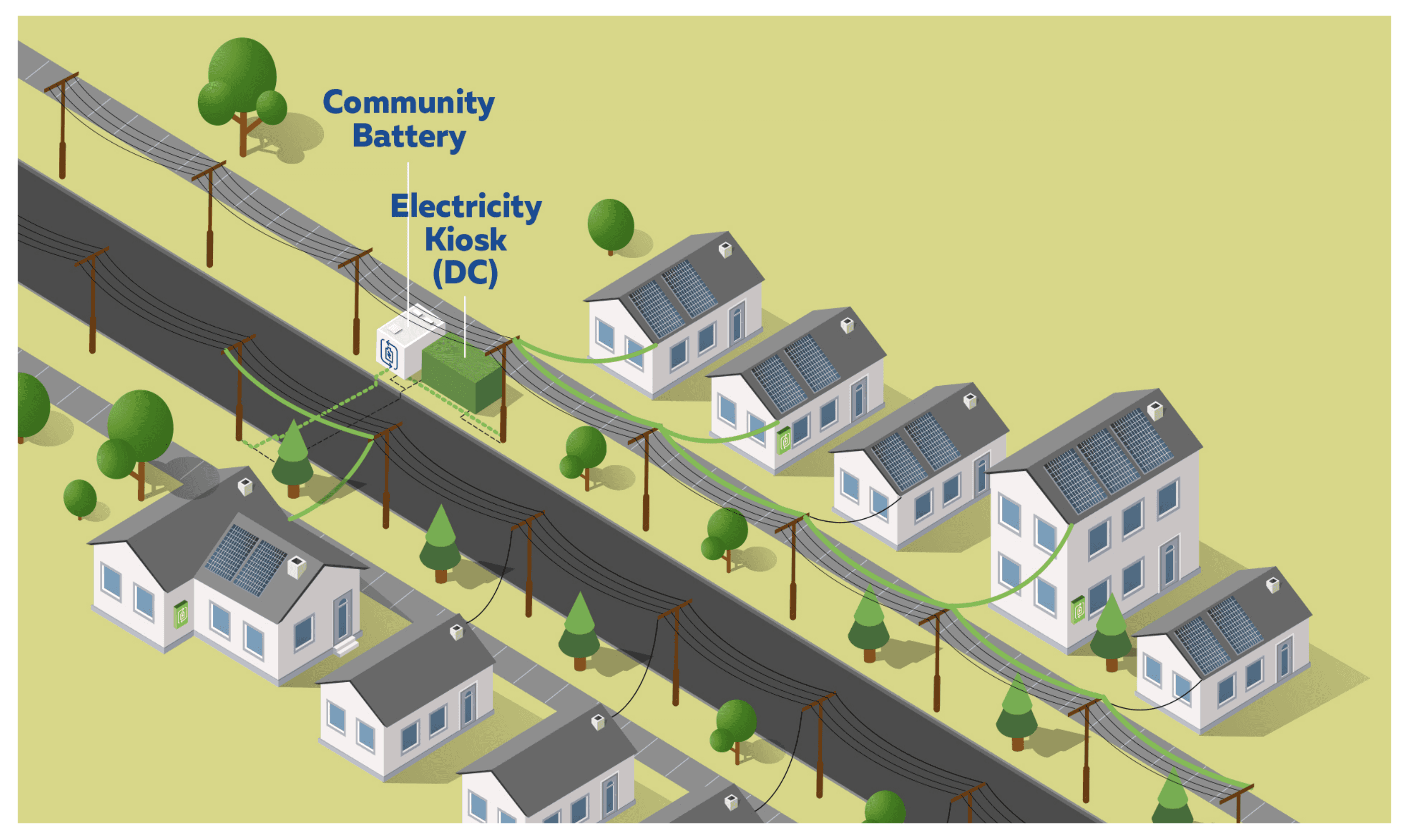
Community battery storage is emerging as a practical, inclusive way to unlock more value from rooftop solar while strengthening local grids and lowering household energy costs. Recent rollouts in states such as New South Wales, Victoria, and Western Australia show the model moving from pilots to scaled deployment, with utilities and councils collaborating under national funding to install hundreds of batteries across suburbs and regions.
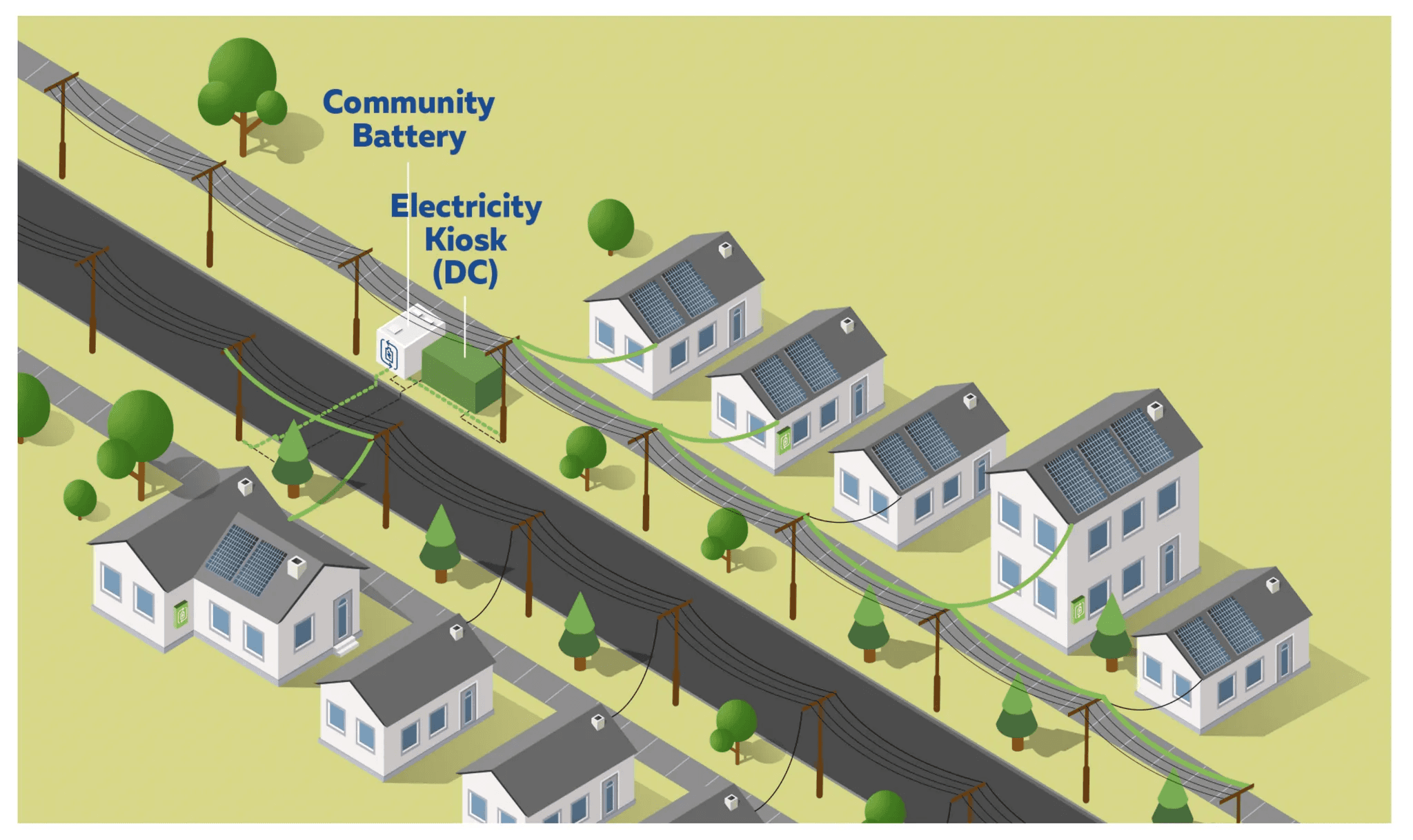
Image Source: WEF
What it is
A community battery is a shared, distribution‑connected storage unit that stores excess daytime solar and releases it later, acting like a collective “energy bank” for nearby homes and small businesses. Typical systems range from 50 kW to 5 MW and are placed strategically on local feeders to relieve congestion, support higher solar penetration, and improve reliability during peak demand or outages. Households can participate whether or not they own panels, often via retail or network programs that let them “rent” capacity to arbitrage tariffs and capture solar that would otherwise be curtailed.
Example & Why it matters now
An example - Australia’s rapid rooftop solar growth is pushing distribution networks to manage midday exports and evening peaks more efficiently, and shared batteries provide a flexible, lower‑cost alternative to traditional poles‑and‑wires upgrades. By shifting local solar into evening use, these assets can reduce bills, cut emissions, and defer grid investments, with market participation (e.g., FCAS) adding revenue streams where permitted. Placing storage close to load also improves resilience for regional communities by stabilizing voltage, easing congestion, and supporting critical services during disturbances.
Policy and funding momentum
The Australian Government set aside AU$200 million for the Community Batteries for Household Solar program, aiming for 400 batteries nationwide and tasking ARENA with allocating the bulk of funding. Round 1 supported hundreds of sites across multiple states, spanning both network and non‑network proponents from distribution companies to councils and energy retailers. In February 2025, ARENA launched Round 2 with AU$46.3 million, seeking projects between 50 kW and 5 MW that enhance economics, integrate distributed energy resources, and demonstrate multi‑benefit use cases.
On‑the‑ground progress
Endeavour Energy has completed an initial stream of ten community batteries in New South Wales with Origin Energy, including a new system at East Bowral that invites residents to participate and save without owning a behind‑the‑meter battery. The utility is continuing deployment under the Commonwealth program and additional ARENA‑supported streams, illustrating how coordinated rollouts can standardize design, operations, and customer offers across suburbs. Similar initiatives are accelerating in other states, with dozens of batteries announced in 2025 across NSW and Victoria through federal grants and state‑level support.
What to watch next
Business models: Expect more hybrid value stacks combining local peak shaving, export management, retail tariff arbitrage, and market services where rules allow.
Community participation: Clear enrollment pathways via retailers and councils can broaden access for renters and apartment dwellers while improving utilization and revenue stability.
Standards and rules: Consistent definitions, metering, and market access frameworks will help scale from pilots to programmatic deployment at lower cost and higher impact.
With strong policy backing and maturing delivery models, community batteries are shifting from concept to core grid asset, helping households capture more of their solar, easing stress on local networks, and accelerating the path to a reliable, renewables‑based power system.
As these models solidify in Australia, they offer a blueprint for regions facing similar challenges such as overloaded feeders, rising rooftop solar adoption, or the need for more flexible local capacity. In markets across Europe, the US, Asia, and the Middle East, community scale storage could become a catalyst for expanding distributed energy participation without requiring every household to invest individually. Tokenization adds another layer by enabling new financing pathways that aggregate community level projects into investable digital assets, helping local networks scale deployment faster while giving communities and private capital clearer, more transparent ways to participate in the clean energy buildout.
About Penomo
Penomo is the AI-native operating system for private markets transactions.
We power private credit, private equity, and M&A workflows through modular infrastructure and powerful AI agents built for the real complexity of deal execution - from origination, underwriting and monitoring - designed by operators with deep experience in the space.
Our flagship product CredOS actively operates across Europe and North America enabling lean teams in private credit & infrastructure investment operations to operate at institutional scale. We address the €250B+ annual spend on fragmented, manual layers of private markets that is increasingly converging with the emerging €1T digital asset ecosystem.
→ Get hands-on: Start 7-Day Trial.