Penomo @SuperReturn Berlin - AI in Energy Transition Finance. Read more
3
min
For years, tokenization lived in the land of “almost.”
Almost ready.
Almost institutional.
Almost useful.
That’s changed.
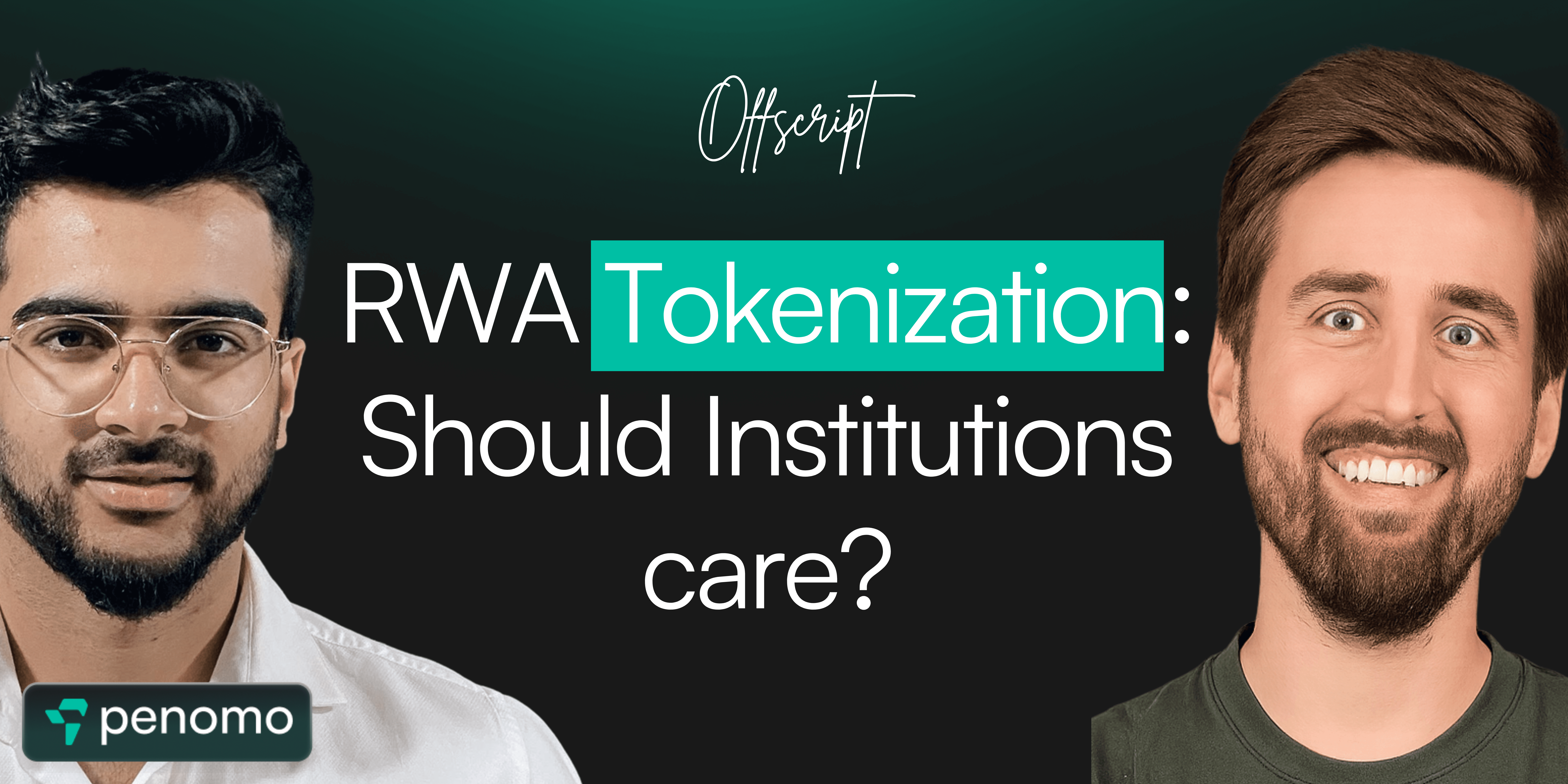
In this Offscript episode, we spoke with Jeroen, Co-Founder and CTO of Centrifuge, one of the few teams that stayed focused long enough to build real infrastructure for real-world assets (RWAs).
And the takeaway was clear: the debate is no longer if tokenization happens… it’s how fast and who controls the rails.
Why RWAs Took So Long
Five years ago, talking about bringing traditional finance on-chain was borderline heretical. Crypto lived in isolation. Institutions didn’t trust the rails. Compliance and custody were unsolved.
Centrifuge entered the space early, arguably too early, and spent years learning what not to build. That patience paid off.
Today, tokenized funds, credit products, and indices aren’t experiments. They’re deployed, used, and measured.
V3 White Label: Stop Rebuilding the Same Infrastructure
One of the biggest blockers to RWA scale was duplication.
Every project rebuilt:
Vaults
Oracles
Token standards
Compliance logic
Centrifuge’s V3 White Label flips that model. Instead of rebuilding, teams plug into a shared, audited infrastructure and focus on what actually differentiates them: asset selection, risk, and distribution.
Tokenization only scales when specialization replaces reinvention.
Proof of Index: Transparency Without Giving Away the Crown Jewels
Index tokenization introduces a unique problem: verification without exposing proprietary data.
Proof of Index solves this by allowing investors to validate what they’re holding without revealing the underlying index construction. It’s not just a technical achievement - it’s a governance one.
Institutions won’t move on-chain if it means losing control of their IP. This is how that tradeoff gets resolved.
Liquidity Is Not Magic
One of the most grounded moments in the conversation was also the most necessary:
Tokenization does not magically make assets liquid.
Private credit is still private credit. Long-duration assets still have duration risk. What tokenization does offer is:
Better secondary markets
Programmable settlement
Wider distribution
Clearer transparency
Liquidity improves - but only when incentives align.
Standards Matter More Than Chains
ERC-7540 might not trend on Twitter, but it matters more than most new L1 launches.
Without standards, DeFi doesn’t scale. Asynchronous settlement is a reality for RWAs, and pretending everything can be atomic breaks composability.
This is the unglamorous work that determines whether institutional finance actually plugs into DeFi, or stays adjacent forever.
Institutions Aren’t Just FOMO-Driven
Yes, fear of missing out plays a role. But what’s more interesting is that institutions are arriving for different reasons:
Operational efficiency
Distribution
Yield optimization
New investor access
That diversity of motivation is a good sign. It means tokenization isn’t a single narrative - it’s a toolbox.
What’s Next: The Build Phase
The infrastructure is here.
The standards exist.
The institutions are moving.
The next phase isn’t about explaining tokenization, it’s about building on top of it. Energy, infrastructure, credit, indices. Real assets, real yields, real constraints.
And this time, the rails might actually hold.
Watch the full episode here:
About Penomo
Penomo is the AI-native operating system for private markets transactions.
We power private credit, private equity, and M&A workflows through modular infrastructure and powerful AI agents built for the real complexity of deal execution - from origination, underwriting and monitoring - designed by operators with deep experience in the space.
Our flagship product CredOS actively operates across Europe and North America enabling lean teams in private credit & infrastructure investment operations to operate at institutional scale. We address the €250B+ annual spend on fragmented, manual layers of private markets that is increasingly converging with the emerging €1T digital asset ecosystem.
→ Get hands-on: Start 7-Day Trial.