
Penomo's next chapter with Ava Labs. Read more
Jan 19, 2026
3
min
For decades, finance expanded without truly evolving.
Capital moved faster. Products multiplied. Balance sheets grew.
But the infrastructure - the way money actually flows - stayed largely the same.
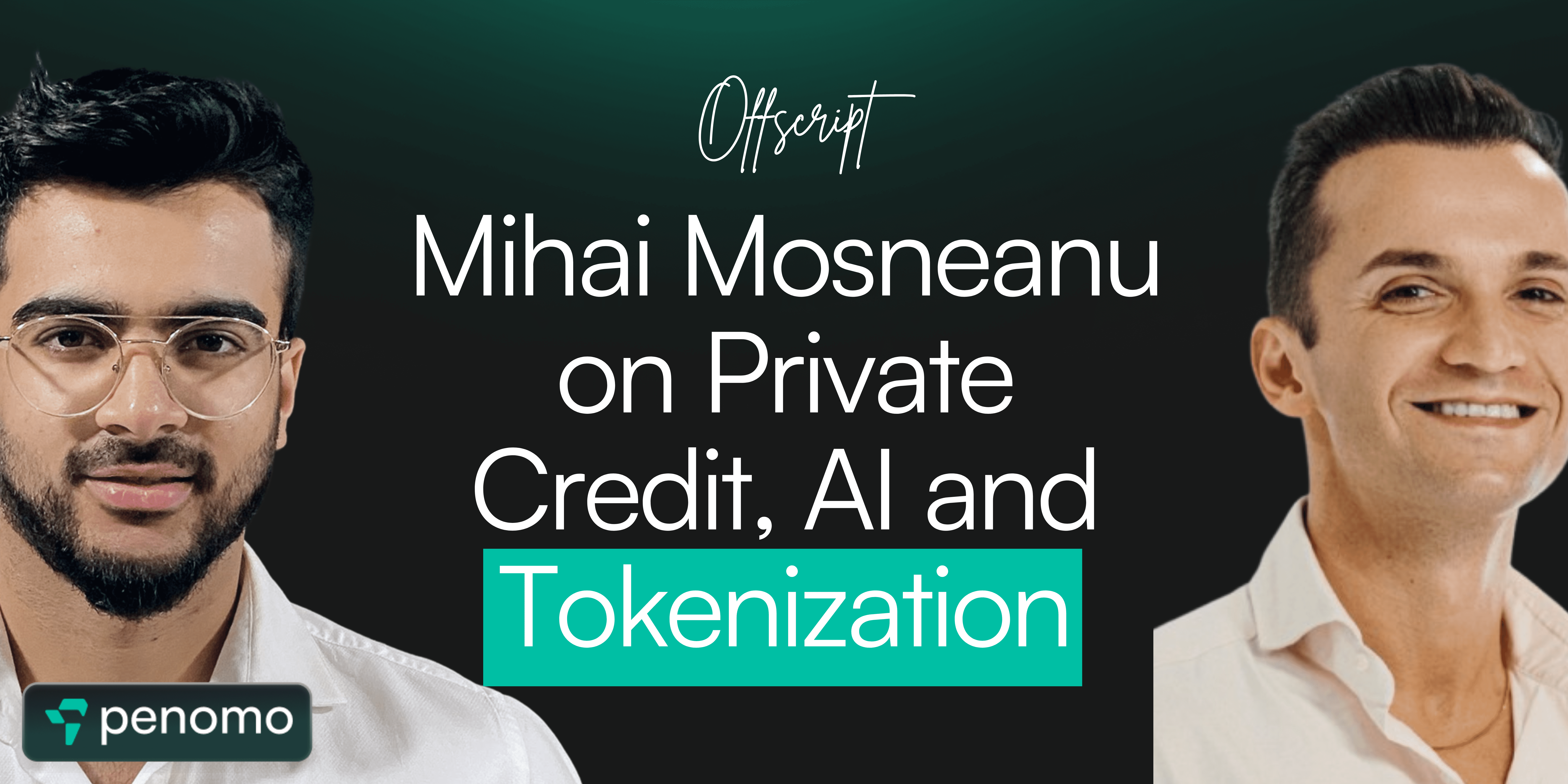
In this Offscript conversation, we sat down with Mihai, senior advisor at Penomo and former JP Morgan and Barclays executive, to unpack why that stagnation exists, what finally broke it, and why the convergence of blockchain and AI may be the most meaningful shift finance has seen since Bretton Woods.
Finance Grew… Innovation Didn’t
Mihai’s move from traditional finance to on-chain systems wasn’t ideological. It was structural.
For more than 15 years, he worked inside the global financial system, emerging markets, private credit, development finance, infrastructure syndication. He saw how capital is allocated, how risk is priced, and where the system quietly breaks.
The insight that stayed with him was simple but uncomfortable:
Finance scaled through globalization, not innovation.
Since World War II, layers were added - deregulation, electronic trading, complex instruments - but the core mechanics barely changed. Settlement delays, reconciliation errors, fragmented data, and excessive intermediaries remain standard practice.
That inertia isn’t accidental. When systems generate consistent profits, there’s little incentive to rebuild them.
Inertia Is the Hidden Enemy of Progress
Large institutions aren’t anti-innovation. They’re optimized for stability.
Banks like JP Morgan have spent decades refining processes that work at scale. When revenues are strong and shareholders are satisfied, changing foundational systems feels like unnecessary risk.
Innovation happens, but in isolated units:
Blockchain labs
AI task forces
Experimental payment rails
These run parallel to the core business, not through it.
That separation is deliberate. It protects the institution from disruption - but also slows transformation.
The result? Innovation exists, but rarely reaches the balance sheet.
Why Institutions Are Finally Moving
The current shift toward blockchain and tokenization isn’t driven by ideology or fear alone. It’s driven by economics.
Mihai breaks institutional motivation into two categories:
1. Cost and Risk Reduction
The traditional financial stack is inefficient by design:
T+2 settlement
Manual reconciliation
Multiple custodians and agents
High operational risk
Tokenization and blockchain introduce:
Atomic settlement
Real-time visibility
Reduced counterparty risk
Lower operational overhead
This isn’t about replacing banks. It’s about making them function better.
2. New Revenue Streams
Institutions aren’t just defending margins — they’re chasing growth.
Crypto-native assets, tokenized instruments, and digital markets create:
New advisory fees
Trading opportunities
Financing products
Balance-sheet optimization
That’s why banks are no longer observers. They’re participants.
Emerging Markets: Where Capital Is Needed Most and Mispriced Most Often
Much of Mihai’s career focused on emerging markets, where capital gaps are largest and risk is hardest to price.
The problem isn’t lack of opportunity - it’s friction:
FX volatility
Political risk
Enforcement uncertainty
Poor post-investment visibility
Traditional finance mitigates these risks through structure, guarantees, and legal frameworks. But it does so at a cost — making financing expensive and slow.
This is where on-chain systems quietly change the equation.
Not by eliminating risk, but by making it measurable, transparent, and manageable in real time.
Infrastructure Finance Is Built for Tokenization
Energy and infrastructure assets share key characteristics:
Long duration
Predictable cash flows
Clear milestones
High capital requirements
They’re ideal candidates for:
Automated payment flows
Smart-contract-based disbursement
Transparent performance tracking
When milestones trigger payments automatically, capital leakage drops.
When AI monitors operational signals continuously, risks surface earlier.
This isn’t theoretical. It’s operational leverage.
AI Isn’t Replacing Judgment; It’s Removing Blind Spots
Mihai is clear: AI doesn’t eliminate human responsibility. It removes agency risk.
In traditional finance, decision-makers rely on delayed, filtered, and incomplete information. AI changes that by:
Aggregating signals across markets
Monitoring borrower behavior
Flagging early-stage risk
Reducing manual overhead
But only if inputs are clean.
Bad data doesn’t create insight — it creates faster mistakes.
That’s why AI works best when paired with structured, transparent systems - exactly what blockchain provides.
Why This Matters More Than Crypto Prices
The most important insight from the conversation isn’t technical — it’s philosophical.
Finance has spent decades engineering products without improving access, velocity, or fairness of capital flows.
Blockchain and AI don’t solve everything. But together, they finally address the mechanics of finance:
How money settles
How risk is monitored
How capital reaches real projects
That’s why this shift isn’t cyclical. It’s structural.
Final Thought: Build, Don’t Compete
Mihai closed the conversation with advice that applies well beyond finance:
Build. Don’t settle. And treat others as partners, not competitors.
The future of finance won’t be owned by a single institution or protocol. It will be assembled - piece by piece - by those willing to rethink foundations instead of layering over them.
This time, the infrastructure might actually change.
Watch the full Offscript episode here:
About Penomo
Penomo is a digital asset infrastructure platform specializing in tokenized energy and AI infrastructure financing.* Through tokenization technology, Penomo is streamlining financing processes, enhancing liquidity, and enabling efficient financing for the global energy transition and AI expansion.
The time to lead is now!
→ Curious if tokenized capital fits your project? Take 2 minutes to find out.
Connect with us: Website | X | Telegram | TG Announcements | Discord | LinkedIn